
Compare Autauga County Property Value Types
No single figure defines an Autauga County property value. The Citizen Access Portal breaks a record into land, improvement, market or final, appraised, assessed, taxable, and tax fields. A recorded consideration amount sits apart from all of these, on the deed trail. Every number carries its own date and purpose. Identify both before you line a figure up against a sale or an appraisal.
| Value | What It Is | Where |
|---|---|---|
| Market or final value | County mass-appraisal estimate before the class ratio | Revenue parcel card |
| Assessed value | Market/appraised value multiplied by the Alabama class ratio | Revenue parcel card |
| Taxable value | Value used after applicable exemption or statutory treatment | Parcel detail and tax record |
| Sale consideration | Amount stated or reflected in a recorded conveyance | Probate deed trail |
| Land and improvement | Separate components of the county valuation | Revenue parcel card |
One parcel illustrates the math. It shows a $322,300 final value beside a $64,460 assessed value, which is exactly the 20 percent Class II ratio at work. Neither figure means the property sold for that amount. Alabama sets ratios of 30 percent for Class I, 20 percent for Class II, 10 percent for Class III, and 15 percent for Class IV. The Citizen Access parcel detail displays each value field in context.
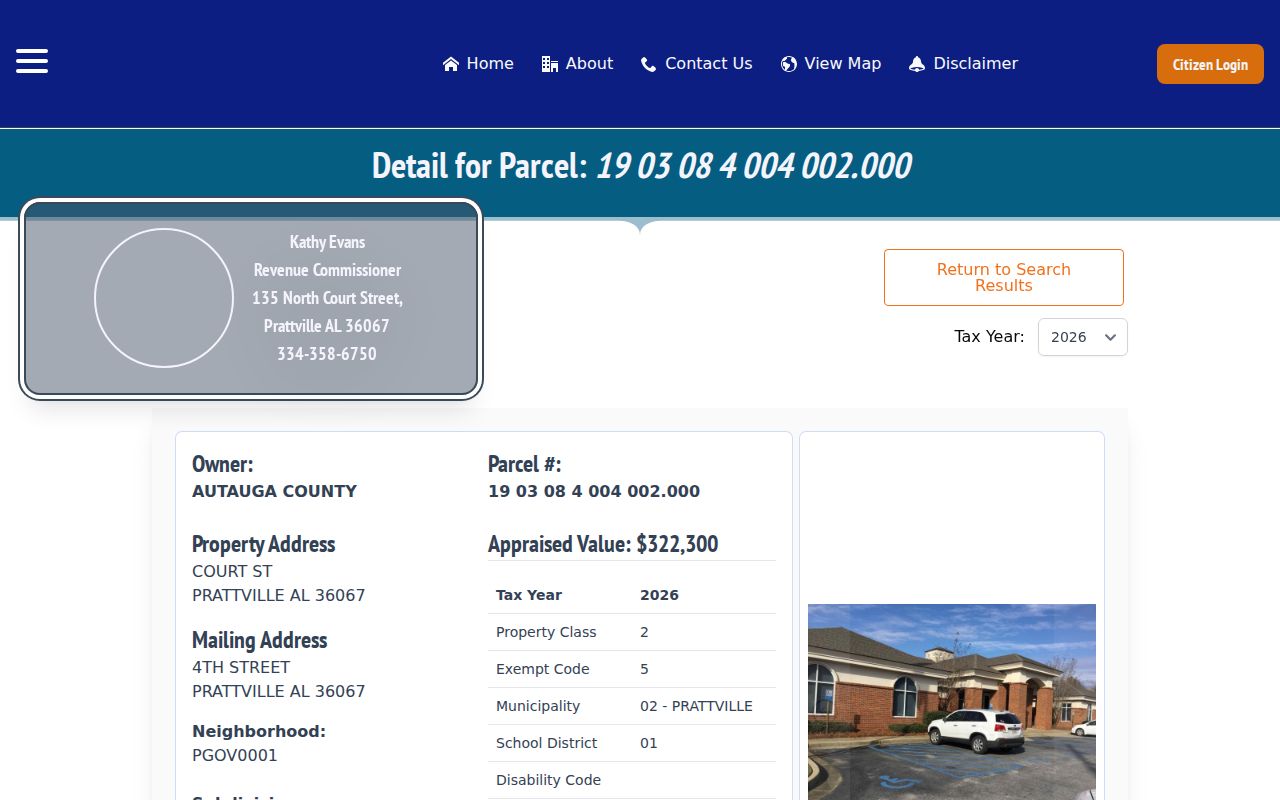
The screen lets you compare fields side by side. It cannot turn an assessed value into a sale appraisal.
Look Up an Autauga County Assessed Value
Pick a roll year first. Citizen Access covers 2020 through 2026, so the same parcel can be compared across annual snapshots. An address search is convenient. The exact parcel number is more reliable, though, when street spelling, rural routes, or a mailing-address mismatch causes a miss.
- Select the assessment year and search by property address.
- Open View Details and record land, improvement, market/final, appraised, and assessed fields.
- Check class, class use, exemption, acreage, and legal remarks that explain context.
- Use the Probate record system for the recorded deed when sale consideration matters.
- Assessed value
- The tax-base amount after the statutory class ratio is applied.
- Market / appraised value
- The county's mass-appraisal figure before that ratio.
- Level of assessment
- The percentage assigned by Alabama law to the property class.
Apply Alabama's Class Ratio to Autauga Values
The Alabama Department of Revenue assessment guide lays out the four class ratios. The class label printed on the Autauga record decides which one applies. Multiply the county's market or appraised figure by that percentage. The result is assessed value, before other taxable-value rules come into play.
Market value: the mass-appraisal estimate. Assessed value: value after the class ratio. Assessment ratio: the statutory percentage. Reassessment: a later official valuation update.
Check the class and class-use fields on the record itself. Never assume a ratio from the building type or how a street looks. Alabama assigns 30 percent to Class I and 20 percent to Class II. Class III carries 10 percent, and Class IV carries 15 percent. An exemption or cap can later change the taxable path. That does not alter what assessed value means. One county-owned parcel offers a clean arithmetic test. Its final value of 322,300 multiplies by the Class II rate of 20 percent. That equals the displayed assessed value of 64,460. The math checks out neatly. But it verifies a field relationship, not a sale price and not a countywide trend.
Separate Autauga Land and Improvement Value
Citizen Access reports land value and improvement value separately. That split shows whether a change came from the site, the structures, or both. Treat it as an assessment allocation rather than a contractor's estimate or a resale forecast. Compare the same parcel in the same year. A changed parcel number can signal a split or recombination. The detailed card may also list more fields. Neighborhood, subdivision, acreage, square footage, section, township, range, and legal remarks appear there. Those fields add context. They still do not make two nearby parcels true comparables. One may differ from the other in several ways. Class, exemption, land use, improvement age, acreage, flood exposure, or municipal setting can set them apart. When improvement value climbs, check permit and planning sources for the story behind it. Prattville maintains its own building and planning routes. Outside that city, County Engineering handles verified flood and permit questions. A permit can explain work. Keep this in mind. The dollars spent on a project do not automatically become dollars added to a county value.
Compare Autauga Property Values From 2020 Through 2026
The portal's year selector makes a restrained trend check possible. Hold the parcel number constant. Then record final or market, assessed, exemption, and taxable figures for each available year. A jump can reflect reappraisal. It can also reflect a changed improvement, class treatment, exemption status, or a parcel event rather than a market sale. Build one row per year with the exact field label. Add the amount, property class, exemption, land value, and improvement value. Save the parcel and key numbers too. If a split or combination changed the parcel, bridge the two accounts through legal remarks, acreage, and Probate instruments before continuing. Annual reappraisal means some year-to-year movement is normal. So treat each selection as a dated public snapshot rather than a daily price chart. Note: Compare fields with the same label across years; never mix assessed value in one year with market value in another.
Keep Alabama's 7 Percent Cap Separate From Market Value
The Alabama DOR cap guidance concerns taxable assessed value under Act 2024-344. A cap on that figure does not rewrite market value. The parcel can still sell for whatever a buyer will pay. The law lists exceptions too. Read the parcel record and the state guidance together before drawing conclusions.
Autauga County owners should keep three stages apart. There is the market or appraised field first. Then comes assessed value after the class ratio. The taxable figure follows any cap or other treatment. A limit on the third stage never freezes the first. Bill calculation, exemptions, and appeals belong with the tax record, not this value page.
Find Autauga Sale Consideration in the Deed Trail
Sale price lives in the deed, not the value field. Autauga County records show no dependable sale-price entry on the parcel account. A past transaction amount may matter at times. Find the conveyance through Probate in that case. Read the recorded instrument itself. A nominal deed, family transfer, or estate deed may say nothing about open market value. The same goes for a corrective filing, foreclosure, or partial-interest sale.
The deed itself supplies the numbers that matter. Book and page tie the transaction to the parcel. So do recording date, grantor, grantee, and legal description. Search by party or instrument type in the Probate land-record system. Its public route runs through account login or Pay-Per-Document. Document images may carry a cost. Deeds outside online coverage can still be requested from Real Property-Records. That route offers office or archive access.
Consideration carries a date too. An old deed amount set against a later county value builds a false trend. There is no note of years, parcel changes, or transfer type in that pairing. Never substitute the current assessed value for the old consideration.
Autauga Exemptions Change Taxable Value
An exemption is a tax device, not a value device. Citizen Access may show an exemption code beside a taxable-value message on an Autauga County account. That display leaves the market or appraised field untouched. It changes how the account moves through assessment and taxation. Alabama rules cover homestead, age, disability, and other state programs. Eligibility always turns on the record and the application on file.
Compare values cleanly. Write the exemption code or text next to each year you review. Two nearly identical Autauga County parcels can land on very different taxable outcomes. An exemption on one account can be the whole reason. Guessing the reason from an owner's age, mailing address, or name leads nowhere. The Revenue Commissioner can explain the account rule and the correction path.
Bill questions, filing deadlines, and appeals belong with the property tax record. The value question is narrower. Which figure is shown, what stage it represents, and which year and class produced it.
Autauga Property Value Context
Maps explain why two Autauga County accounts resist comparison. The county map page lays out flood, school, voting, and commission geography. Prattville GIS layers on zoning, aerial imagery, tax-parcel lines, and scanned plans. Neither source publishes a sale appraisal. Together they frame a parcel without pricing it.
Screen possible comparisons with acreage, subdivision, neighborhood, municipal description, square footage, class use, and legal remarks. When a present market opinion is actually required, obtain a licensed appraisal. A mass appraisal spreads one consistent tax process across many properties at once. A private appraisal answers a different assignment, tied to a specific effective date for one property.
Historic files add a third kind of context. The Autauga County Heritage Association holds deeds, surveys, tax receipts, and Daniel Pratt or Continental Gin papers that can explain an old industrial or historic tract. Those records tell a land-use story. They do not update the current county value.
What an Autauga County Property Value Cannot Prove
A county figure belongs to a mass-appraisal and tax system. It proves none of the following: a current sale price, replacement cost, surveyed acreage, condition, title, flood status, or a private appraisal conclusion. Planning, flood, zoning, and subdivision records supply context. None of them changes what the value field means.
Value vs price. An Autauga assessed value serves taxation. It is not a sale prediction or licensed appraisal, and a recorded price may reflect a non-market transfer.